European jurisdiction by default
Servers, databases, storage, DNS, emailing and analytics are handled primarily through European partners.

This continues our Proudly made in EU principle: we choose key suppliers by jurisdiction, operational control and a strict need for third parties.
Transparent supply chain
Below are suppliers we use for infrastructure, emailing, analytics, form protection and payments. A specific project may use only part of this list.
The goal is not to have the longest processor list. The goal is to know each supplier's role, where infrastructure runs and whether the service should be involved at all.
8
suppliers in the core stack
Not every project uses all of them. Scope follows the actual data flows.
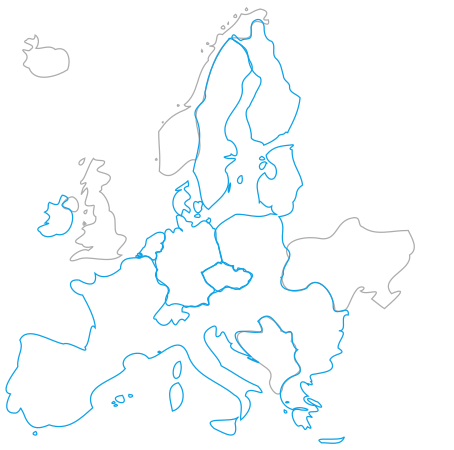
6
EU suppliers
Key infrastructure and operational services stay primarily under European jurisdiction.
1
self-hosted non-EU exception
We use Umami as software while analytics data remains on our own servers.







How we choose
For every supplier we look at operational role, jurisdiction, data location and our ability to keep critical layers under control.
Servers, databases, storage, DNS, emailing and analytics are handled primarily through European partners.
We add services only when they have a clear purpose. Global platforms are not our automatic default.
When self-hosting makes sense, we run the tool on our infrastructure and separate software vendor from data custody.
Active suppliers
This list describes our common operating baseline. For client projects we confirm the exact use, scope and contractual setup.
Germany + Finland
Jurisdiction: German supplier, primary operations in Germany, redundancy in Finland.
Role: Main infrastructure supplier.
What we use the supplier for
Control note: Primary layer for projects where we want operations, data and redundancy to remain in the EU.
France
Jurisdiction: French infrastructure supplier.
Role: Secondary infrastructure supplier.
What we use the supplier for
Control note: Used where a French EU alternative or a secondary layer outside primary hosting makes sense.
Czechia
Jurisdiction: Czech domain and hosting supplier.
Role: Domains, DNS and smaller PHP application servers.
What we use the supplier for
Control note: Useful for Czech domains, simpler website operations and cases where a local supplier is appropriate.
Netherlands
Jurisdiction: Dutch partner for email infrastructure.
Role: Main emailing partner.
What we use the supplier for
Control note: Used for operational communication where deliverability and a European partner matter.
Switzerland
Jurisdiction: Swiss supplier of a self-hosted form protection tool.
Role: Self-hosted spam protection.
What we use the supplier for
Control note: We deploy it self-hosted, so form protection runs in an environment we manage.
USA, self-hosted in the EU
Jurisdiction: US analytics software supplier; analytics data remains on our servers.
Role: Self-hosted analytics platform.
What we use the supplier for
Control note: The exception is the software supplier outside the EU, not default storage of analytics data outside our infrastructure.
Estonia
Jurisdiction: Estonian privacy-first analytics supplier.
Role: Analytics for projects that do not need self-hosting.
What we use the supplier for
Control note: Chosen where hosted analytics with an EU-only approach is enough and a dedicated instance is unnecessary.
Czechia
Jurisdiction: Czech payment gateway with an EU-only approach.
Role: Payment gateway.
What we use the supplier for
Control note: Based on supplied information, Comgate runs its own infrastructure and does not use AWS or Google Cloud.
Where context matters
Not every entry means the same kind of processing. What matters is where data actually runs and who can access it.
We use it self-hosted. That means analytics data is kept on our infrastructure and Umami is not the default external data store.
An e-commerce project may need a payment gateway, while a presentation website may not. SaaS can have stricter requirements for infrastructure, backups and auditability.
Want to build on the EU-first approach? Read Proudly made in EU or review your current stack with us.
FAQ
Contact
The initial consultation is non-binding. Within 24 hours you’ll know if we’re a good fit.